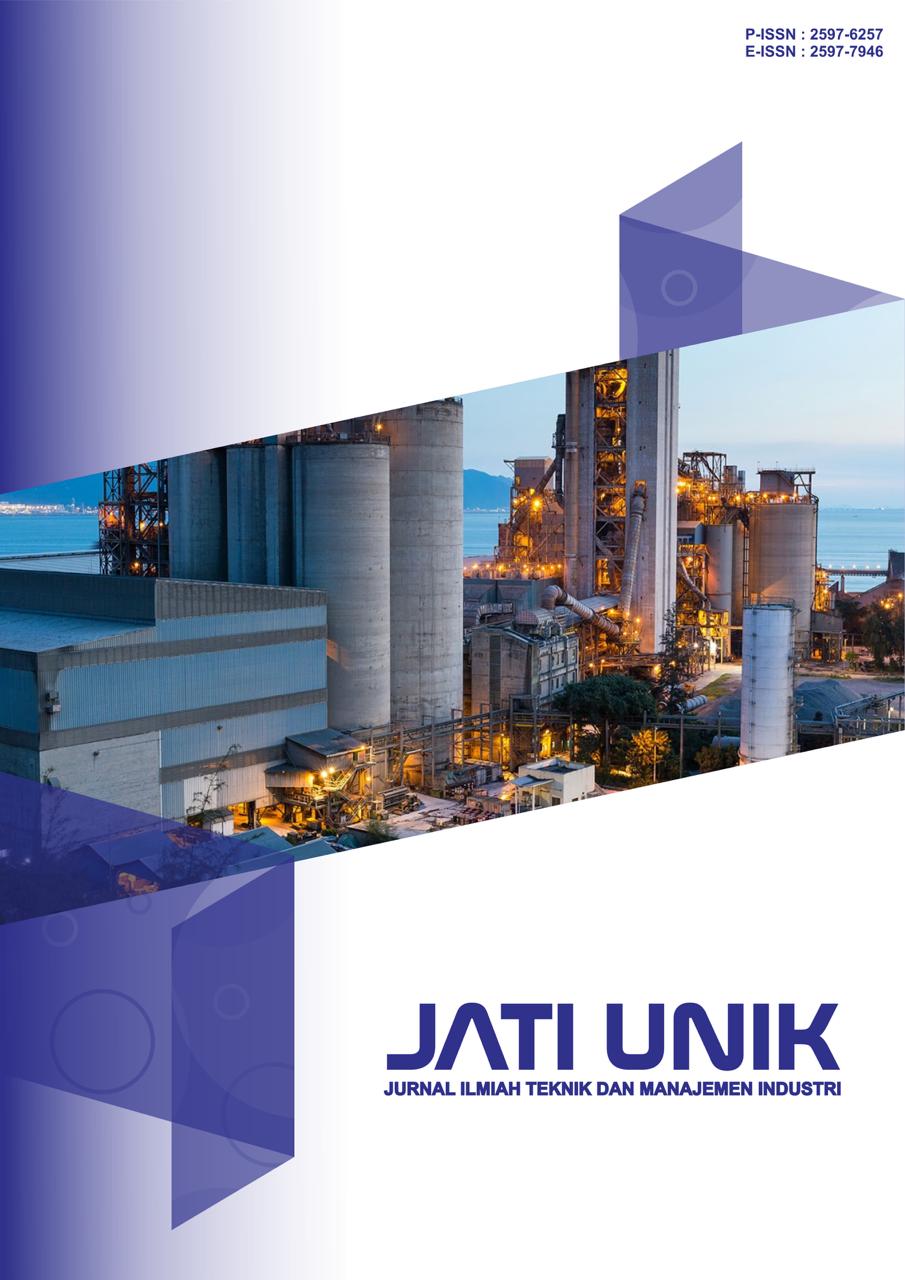
Analisis Potensi Bahaya dan Pengendalian Risiko Aktivitas InspectReplace Liner Chute Menggunakan Metode HIRARC
DOI:
https://doi.org/10.30737/jatiunik.v10i1.8083Keywords:
Confined Space, HIRARC, Inspect Replace Liner Chute, Risk AssessmentAbstract
This study analyzes hazards and risk controls for the Inspect Replace Liner Chute activity at PT Catur Cahaya Niaga Mitra using Hazard Identification, Risk Assessment, and Risk Control (HIRARC). The work involves confined spaces, work at height, heavy components, lifting equipment, and hot work. A descriptive quantitative approach was used, drawing on field observation, interviews, and company records. Likelihood and severity were rated on five-level scales, and risk was calculated as R = L × S. The identified hazards include slips and trips, cuts and pinch points, falling manholes or liners, falls into the chute, respiratory distress in a confined space, and fire. The results show initial risk categories of High (57%), Medium (41%), and Low (2%). After recommended controls were assessed, the estimated residual categories were Low (54%) and Medium (46%), with High and Extreme at 0%. Controls include housekeeping, lever hoists, securing ladders and loads, full-body harnesses, confined-space entry procedures, gas testing, ventilation, hot-work permits, fire blankets, fire watch, and suitable personal protective equipment. Because documentation is insufficient to verify each control in the field, the residual distribution should be interpreted as an assessment estimate rather than measured evidence of reduced accidents.References
[1] M. Yusuf et al., “Understanding Occupational Health and Safety Regulations and the Influence on Students’ Behavior in Practical Workshops,” Kesmas: Jurnal Kesehatan Masyarakat Nasional, vol. 20, no. 2, pp. 95–103, 2025, doi: 10.7454/kesmas.v20i2.1628.
[2] D. H. Ramdhan, Manajemen Risiko. 2006.
[3] S. Aprilia, H. Kurnia, W. T. Setyawan, E. Ashar, and A. Wahyudi, “Peninjauan Keselamatan dan Kesehatan Kerja (K3) terhadap Aktifitas Kerja Karyawan di Berbagai Perusahaan secara Kajian Sistematik,” Industry Xplore, vol. 8, no. 1, pp. 203–211, 2023, doi: 10.36805/teknikindustri.v8i1.5102.
[4] R. R. Simbolon, F. P. Harramain, and M. R. P. Sonjaya, “Pentingnya Penerapan Keselamatan dan Kesehatan Kerja (K3) sebagai Faktor Penentu Optimalisasi Produktivitas Kerja,” Pajak dan Manajemen Keuangan, vol. 1, no. 3, pp. 17–31, 2024, doi: 10.61132/pajamkeu.v1i3.122.
[5] K. Fahruddin and M. C. P. A. Islami, “Risk Management In The Procurement Process of Upstream Oil Companies Using The House of Risk and Interpretive Structural Modelling: Manajemen Risiko Pada Proses Pengadaan Perusahaan Hulu Minyak Menggunakan Metode House Of Risk Dan Interpretive Structural Modelling,” JATI EMAS (Jurnal Apl. Tek. dan Pengabdi. Masyarakat), vol. 9, no. 1, pp. 115–120, 2025.
[6] P. Poniman and S. A. Mandati, “Kriteria Identifikasi Bahaya, Penilaian dan Pengendalian Risiko Departemen Fabrikasi PT Unindo Pasifik,” JATI UNIK J. Ilm. Tek. dan Manaj. Ind., vol. 4, no. 1, pp. 28–39, 2020, doi: 10.30737/jatiunik.v4i1.955.
[7] S. Sarjana et al., Manajemen Risiko. Bandung: CV Media Sains Indonesia, 2022.
[8] O. Arifudin, U. Wahrudin, and F. D. Rusmana, Manajemen Risiko. Bandung: Penerbit Widina, 2020.
[9] Suriyadi and F. Azmi, “Pengembangan Manajemen Resiko pada Instansi Pendidikan,” Majalah Ilmiah Warta Dharmawangsa, vol. 16, no. 3, pp. 543–553, 2022, doi: 10.46576/wdw.v16i3.2246.
[10] D. V. D. Doda and M. Pangaribuan, Dasar Kesehatan dan Keselamatan Kerja: Hazard/Bahaya di Tempat Kerja (Buku Referensi). Bandung: CV Patra Media Grafindo, 2022.
[11] F. N. Azzahra, M. Sultan, I. A. I. D. Lestari, I. M. Ramdan, and D. N. Hardianti, “Faktor-Faktor yang Berhubungan dengan Manajemen Pengendalian Bahaya Kimia sebagai Upaya Pencegahan Bahaya di Laboratorium PT. X Kota Balikpapan,” J. Keselam. Kesehat. Kerja dan Lingkung., vol. 6, no. 1, pp. 33–41, 2025.
[12] Tajudin and I. R. Ramli, “Analisis Beban Kerja untuk Menentukan Jumlah Tenaga Kerja pada Departemen Packing Menggunakan Metode Full Time Equivalent (Studi Kasus PT Adi Satria Abadi Kalasan),” Jurnal Rekayasa Industri (JRI), vol. 6, no. 2, pp. 159–166, 2024.
[13] A. K. S. Jardine and A. H. C. Tsang, Maintenance, Replacement, and Reliability: Theory and Applications, 2nd ed. Boca Raton, FL, USA: CRC Press, 2013.
[14] H. Fadili, M. F. Perdana, Suryadi, and D. Suryapranatha, “Identifikasi Potensi Bahaya Keselamatan dan Kesehatan Kerja dengan Menggunakan Metode HIRARC (Studi Kasus: PT. GGS),” Jurnal Teknologi dan Manajemen Industri Terapan, vol. 4, no. 3, pp. 802–814, 2025.
[15] I. K. Wiryajati and I. A. S. Adnyani, Metode Hazard Identification Risk Assessment and Risk Control K3. Penerbit Adab, 2025. [Online]. Available: https://books.google.co.id/books?id=q72JEQAAQBAJ
[16] S. M. Putra, I. K. Wiryajati, and I. A. S. Adnyani, “Dealing with Occupational Health and Safety Practices Using JSA with HIRARC Method,” Int. J. Informatics Comput., vol. 7, no. 1, pp. 193–205, 2025.
[17] H. Mauliyani, N. Romdhona, A. Andriyani, and M. Fauziah, “Identifikasi Risiko Keselamatan Kerja Metode (HIRARC) pada Tahap Pembuatan Tangki di PT. Gemala Saranaupaya,” Environmental Occupational Health and Safety Journal, vol. 2, no. 2, pp. 163–174, 2022.
[18] E. Farida, Q. Sholihah, S. Andarini, and M. H. Natsir, “Analisis Faktor Kunci dan Tantangan dalam Pemenuhan Standar Keselamatan dan Kesehatan Kerja (K3) untuk Mencapai Infrastruktur yang Berkualitas: Sebuah Literatur Review,” Konstruksi: Publikasi Ilmu Teknik, Perencanaan Tata Ruang dan Teknik Sipil, vol. 2, no. 3, pp. 83–99, 2024, doi: 10.61132/konstruksi.v1i3.362.
[19] M. Timothy, “Hazard Identification, Risk Assessment and Risk Control (HIRARC) pada CV Lisa Jaya Mandiri Food,” J. Titra, vol. 10, no. 2, 2022.
[20] H. H. Marfuah, Y. Tri Hapsari, and Kurniawanti, “Analisis Potensi Bahaya dengan Metode Hazard Identification, Risk Assessment and Determine Control (HIRADC) Studi Kasus: UMKM Logam di Yogyakarta,” J. Rekayasa Ind., vol. 6, no. 1, pp. 62–73, 2024, doi: 10.37631/jri.v6i1.835.
[21] R. Kristiana et al., Manajemen Risiko. Sumedang: Mega Press Nusantara, 2022.
[22] M. G. D. Devedo, A. Ismail, and R. Nadhirawty, “Identifikasi Risiko Keterlambatan dalam Pembangunan Perumahan Cluster Verdi Summarecon,” Teknol. Sipil J. Ilmu Pengetah. dan Teknol., vol. 9, no. 1, pp. 62–69, 2025.
[23] T. Dahniar and F. D. Ibnu, “Penerapan Metode HIRARC untuk Pengelolaan Risiko Kesehatan dan Keselamatan Kerja di Industri Besi,” Ind. Inov. J. Tek. Ind., vol. 15, no. 1, pp. 34–39, 2025.
[24] P. Giananta, J. Hutabarat, and S. Soemanto, “Analisa Potensi Bahaya dan Perbaikan Sistem Keselamatan dan Kesehatan Kerja Menggunakan Metode HIRARC di PT. Boma Bisma Indra,” J. Valtech, vol. 3, no. 2, pp. 106–110, 2020.
[25] Standards Australia/Standards New Zealand, AS/NZS 4360:2004 Risk Management. Sydney, NSW, Australia: Standards Australia, 2004.
Downloads
Published
Issue
Section
License
Copyright (c) 2026 Nispi Azzumardi, Ananda Syalsabila Hidayat, Sri Wahyuni, Irwanto

This work is licensed under a Creative Commons Attribution-ShareAlike 4.0 International License.
Information regarding Copyright and Licensing at JATI UNIK as follows:
- Licensed Use of Non - Commercial Articles will be governed by the Creative Commons Attribution license, which is featured on the Creative Commons Attribution Non-Commercial Share A Like 4.0 International License.
- The author guarantees that the articles published through JATI UNIK are original and do not contain statements that violate the law do not violate others' rights are subject to copyright, which is held exclusively by the author and free from the rights of third parties. The author is allowed to quote from various sources used for research and not to harm any party.
- JATI UNIK disseminates articles published with the rules set by Creative Commons. UNIK JATI license allows users to copy, distribute, display, and work for non-commercial purposes. Users also need to connect authors and JATI UNIK with the distribution of articles in journals.
- The Author rights, namely copyrights, ownership rights, patents, rights to use the substance of articles in the future, rights to reproduce articles for personal purposes and not to be traded, rights to conduct personal archives, rights to contract used for the non-exclusive distribution of articles published in the form a book and acknowledge the initial publication of the article originating from JATI UNIK.
- Suppose articles published by the author through JATI UNIK are compiled with other authors. In that case, it is necessary to create a form containing the authority of all authors involved in the article's production by including the agreement agreed upon by all authors in the article.
- The next point is, the agreement can be terminated if the author or JATI UNIK violates the agreement and cannot make repairs to the customer within a maximum of 2 months after being given information asking for the violation to be corrected. If there is no violation of the agreement, the license will automatically terminate and affect UNIQUE JATI UNIK.
- Regarding royalties, so far, if it is following applicable legal regulations, the author will waive his right to collect royalties on articles that have been licensed by JATI UNIK.
- In publishing the article, the editorial process is successful. JATI UNIK will continue it. JATI UNIK has the right to adjust articles related to punctuation, spelling, capital letters, references used, and usage adapted to JATI UNIK. The author acknowledges that the article can be published and accessed free of charge by the public.