Pemodelan Peramalan Ekspor Kelapa Sawit dan Batu Bara sebagai Produk Komoditas Unggulan untuk Mendukung Perencanaan Ekonomi
DOI:
https://doi.org/10.30737/jatiunik.v10i1.8002Keywords:
ARIMA, Bengkulu regional economy, coal exports, palm oil exports, time series forecastingAbstract
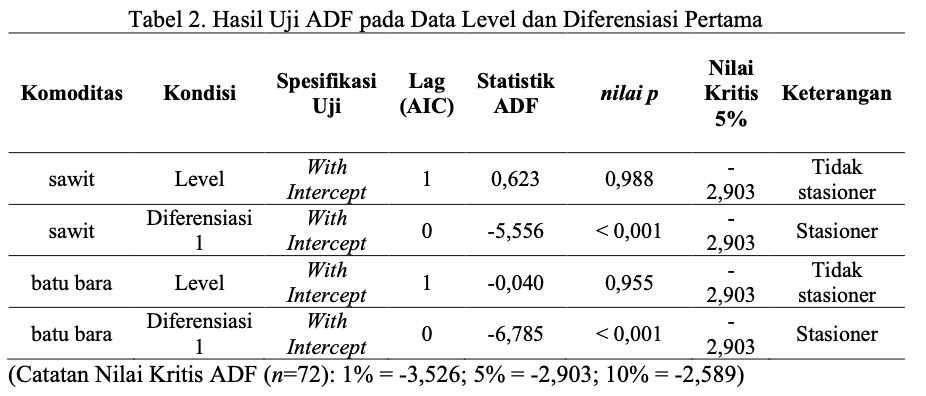
Export and logistics planning in Bengkulu Province requires forecasting information that accounts for differences between the region’s leading commodities. This study aims to analyze historical patterns, select appropriate ARIMA models, and evaluate short-term forecasts of palm oil and coal export volumes to support operational planning at Pulau Baai Port. A quantitative approach was adopted, with each commodity modeled independently using the Autoregressive Integrated Moving Average (ARIMA) method. Monthly data from January 2019 to December 2024 were used for model development, while data from January to June 2025 were reserved for out-of-sample testing. Modeling followed the Box–Jenkins procedure, including stationarity testing, model identification, parameter estimation, diagnostic checking, and forecast accuracy evaluation using the Mean Absolute Percentage Error (MAPE). ARIMA(2,1,3) was selected for palm oil exports and ARIMA(0,1,1) for coal exports, yielding MAPE values of 1.79% and 2.13%, respectively. During the testing period, palm oil export forecasts showed an upward trend, whereas coal export forecasts remained relatively constant. Both models produced low percentage errors over the six-month testing period. These findings provide supporting information for storage capacity and shipping planning tailored to each commodity. Applications to subsequent periods require updated data and renewed evaluation, given the limited testing period and the univariate approach, which does not directly incorporate external factors.
References
[1] D. J. A. Sianturi, “Fluctuating Commodity Prices’effect On Indonesian Coal And Palm Oil,” EKUITAS (Jurnal Ekon. Dan Keuangan), vol. 8, no. 1, hal. 67–84, 2024, [Daring]. Tersedia pada: https://doi.org/10.24034/j25485024.y2024.v8.i1.5916
[2] BPS Provinsi Bengkulu, Provinsi Bengkulu Dalam Angka 2025. Bengkulu: Badan Pusat Statistik Provinsi Bengkulu, 2025.
[3] D. N. Gujarati dan D. C. Porter, “Basic Econometrics,” in McGraw-Hill Irwin, in Economics series. , 2009. [Daring]. Tersedia pada: https://books.google.co.id/books?id=6l1CPgAACAAJ
[4] W. A. Lestari, S. Nugroho, dan F. H. W. Widodo, “Forecasting Export Value of Bengkulu Province Through Pulau Baai Harbour with ARIMA, ANN, and Hybrid ARIMA-ANN Approach,” J. Stat. Data Sci., vol. 3, no. 1, hal. 36–41, 2024, doi: 10.33369/jsds.v3i1.41289.
[5] S. Sarfiah dan A. Aripulis, “The Implementation Of Arima Method In Forcasting Indonesian Crude Oil Export, Production And Consumption,” J. REP (Riset Ekon. Pembangunan), vol. 8, no. 1, hal. 122–141, Apr 2023, doi: 10.31002/rep.v8i1.1389.
[6] N. A. Foci, A. J. Muluk, R. M. Nur, Y. Y. M. Zai, S. Salsabila, dan R. Riyantori, “Strategi Peramalan Permintaan Pupuk NPK untuk Optimalisasi Stok di PT. XYZ,” J. Ind. Eng. Manag., vol. 5, no. 02, hal. 154–159, 2024, [Daring]. Tersedia pada: https://doi.org/10.47398/justme.v5i02.75
[7] R. Rosita, A. Asrini, dan D. Veronica, “Determinan Ekspor Batu Bara Indonesia Serta Kontribusinya Terhadap Ekspor Pertambangan dan Pendapatan Negara,” Ebisma (Economics, Business, Manag. Account. Journal), vol. 3, no. 2, hal. 119–126, 2023, [Daring]. Tersedia pada: https://doi.org/10.61083/ebisma.v3i2.36
[8] G. E. P. Box, G. M. Jenkins, G. C. Reinsel, dan G. M. Ljung, “Time Series Analysis: Forecasting and Control,” in Wiley, in Wiley Series in Probability and Statistics. , 2015. [Daring]. Tersedia pada: https://books.google.co.id/books?id=rNt5CgAAQBAJ
[9] R. J. Hyndman dan G. Athanasopoulos, Forecasting: Principles and Practice, edisi ke-3. OTexts: Melbourne, Australia, 2021. [Daring]. Tersedia pada: https://otexts.robjhyndman.com/fpp3/
[10] S. Makridakis, E. Spiliotis, dan V. Assimakopoulos, “The M4 Competition: Results, findings, conclusion and way forward,” Int. J. Forecast., vol. 34, no. 4, hal. 802–808, 2018, [Daring]. Tersedia pada: https://doi.org/10.1016/j.ijforecast.2018.06.001.
[11] H. A. Soleha, W. P. Nurmayanti, U. Hidayaturrohman, R. H. Hirzi, dan A. Septiani, “Penerapan Clustering Time Series pada Pengelompokan Provinsi di Indonesia (Studi Kasus : Nilai Ekspor Non Migas di Indonesia Tahun 2016-2020),” J Stat. J. Ilm. Teor. dan Apl. Stat., vol. 15, no. 2, hal. 286–291, 2022, [Daring]. Tersedia pada: https://doi.org/10.36456/jstat.vol15.no2.a5550
[12] A. A. Rahma dan Desmintari, “Analisis Determinan Volume Ekspor Batubara Indonesia Ke Lima Negara Tujuan Ekspor,” J. Dev. Econ. Digit., vol. 2, no. 2, hal. 90–104, 2023, [Daring]. Tersedia pada: https://doi.org/10.59664/jded.v2i2.6570
[13] R. N. Puspita, “Perbandingan Metode Double Exponential Smoothing Dan Triple Exponential Smoothing Pada Peramalan Nilai Ekspor Di Indonesia,” Jambura J. Probab. Stat., vol. 3, no. 2, hal. 97–109, 2022, [Daring]. Tersedia pada: https://doi.org/10.34312/jjps.v3i2.15590
[14] T. W. Septiarini, A. Rofiqo, E. Pariyanti, dan S. Abdulmana, “Forecast Evaluation of Arima and Anfis for Indonesia’S Monthly Export (2009-2024),” Media Stat., vol. 18, no. 1, hal. 93–104, 2025, [Daring]. Tersedia pada: https://doi.org/10.14710/medstat.18.1.93-104
[15] M. Fahmuddin, Ruliana, dan S. S. Mustika, “Perbandingan Metode ARIMA dan Single Exponential Smoothing dalam Peramalan Nilai Ekspor Kakao Indonesia,” VARIANSI J. Stat. Its Appl. Teach. Res., vol. 5, no. 3, hal. 163–176, 2023, [Daring]. Tersedia pada: https://doi.org/10.35580/variansiunm193
[16] Bustami, A. M. Yolanda, dan N. Thahira, “Forecasting Non-Oil and Gas Exports in Indonesia Using Double and Triple Exponential Smoothing Methods,” Int. J. Ind. Eng. Eng. Manag., vol. 5, no. 1, hal. 45–49, 2023, [Daring]. Tersedia pada: https://doi.org/10.24002/ijieem.v5i1.6211
[17] M. Ihwal, L. Laome, A. Salsabilah, dan R. A. Ningtyas, “Peramalan Ekspor Nonmigas Indonesia Menggunakan Variabel Eksogen Nilai Kurs Dengan Model Arimax,” DJMA Diophantine J. Math. Its Appl. (, vol. 4, no. 1, hal. 42–51, 2025, [Daring]. Tersedia pada: https://doi.org/10.33369/diophantine.v4i1.413498
[18] Y. Herdiyanti dan K. Sukiyono, “Forecasting of Palm Oil Fruit Fresh Bunches (Ffb) Prices in National and Bengkulu Province: Arima Model Application,” Agrisocionomics J. Sos. Ekon. Pertan., vol. 7, no. 1, hal. 194–202, 2023, [Daring]. Tersedia pada: https://doi.org/10.14710/agrisocionomics.v7i1.14730
[19] T. Rahayu dkk., “Forecasting Produksi, Volume Ekspor dan Nilai Devisa Ekspor Minyak Kelapa Sawit di Indonesia Menggunakan Metode Peramalan Arima,” J. IKRAITH-EKONOMIKA, vol. 8, no. 3, hal. 1358–1372, 2025, [Daring]. Tersedia pada: https://journals.upi-yai.ac.id/index.php/IKRAITH-EKONOMIKA/article/view/5933
[20] A. P. A. Masa, A. Prafanto, dan H. J. Setyadi, “Peramalan Ekspor Batu Bara Indonesia Menggunakan Metode Double Exponential Smoothing Brown,” MALCOM Indones. J. Mach. Learn. Comput. Sci., vol. 4, no. 3, hal. 1139–1147, 2024, [Daring]. Tersedia pada: https://doi.org/10.57152/malcom.v4i3.1552
[21] M.-L. Shen, C.-F. Lee, H.-H. Liu, P.-Y. Chang, and C.-H. Yang, “Effective multinational trade forecasting using LSTM recurrent neural network,” Expert Systems with Applications, vol. 182, Art. no. 115199, 2021, doi: 10.1016/j.eswa.2021.115199.
[22] Y. Sasmita, H. Kuswanto, and D. D. Prastyo, “State-dependent model based on singular spectrum analysis vector for modeling structural breaks: Forecasting Indonesian export,” Forecasting, vol. 6, no. 1, pp. 152–169, 2024, doi: 10.3390/forecast6010009.
[23] I. Rafidah and M. D. Kartikasari, “Forecasting of export value in Indonesia using top-down hierarchical time series based on historical proportion,” EKSAKTA: Journal of Sciences and Data Analysis, vol. 5, no. 1, pp. 8-16, 2024, doi: 10.20885/EKSAKTA.vol5.iss1.art2.
[24] A. P. A. Arisanti, Sugito, R. Dapa, and H. Yasin, “ARIMA-EGARCH model approach in measuring non-oil and gas commodity export price fluctuations in Indonesia,” AIP Conference Proceedings, vol. 3504, no. 1, Art. no. 030005, 2026, doi: 10.1063/12.0044741.
Downloads
Published
Issue
Section
License
Copyright (c) 2026 Muhamad Yasin

This work is licensed under a Creative Commons Attribution-ShareAlike 4.0 International License.
Information regarding Copyright and Licensing at JATI UNIK as follows:
- Licensed Use of Non - Commercial Articles will be governed by the Creative Commons Attribution license, which is featured on the Creative Commons Attribution Non-Commercial Share A Like 4.0 International License.
- The author guarantees that the articles published through JATI UNIK are original and do not contain statements that violate the law do not violate others' rights are subject to copyright, which is held exclusively by the author and free from the rights of third parties. The author is allowed to quote from various sources used for research and not to harm any party.
- JATI UNIK disseminates articles published with the rules set by Creative Commons. UNIK JATI license allows users to copy, distribute, display, and work for non-commercial purposes. Users also need to connect authors and JATI UNIK with the distribution of articles in journals.
- The Author rights, namely copyrights, ownership rights, patents, rights to use the substance of articles in the future, rights to reproduce articles for personal purposes and not to be traded, rights to conduct personal archives, rights to contract used for the non-exclusive distribution of articles published in the form a book and acknowledge the initial publication of the article originating from JATI UNIK.
- Suppose articles published by the author through JATI UNIK are compiled with other authors. In that case, it is necessary to create a form containing the authority of all authors involved in the article's production by including the agreement agreed upon by all authors in the article.
- The next point is, the agreement can be terminated if the author or JATI UNIK violates the agreement and cannot make repairs to the customer within a maximum of 2 months after being given information asking for the violation to be corrected. If there is no violation of the agreement, the license will automatically terminate and affect UNIQUE JATI UNIK.
- Regarding royalties, so far, if it is following applicable legal regulations, the author will waive his right to collect royalties on articles that have been licensed by JATI UNIK.
- In publishing the article, the editorial process is successful. JATI UNIK will continue it. JATI UNIK has the right to adjust articles related to punctuation, spelling, capital letters, references used, and usage adapted to JATI UNIK. The author acknowledges that the article can be published and accessed free of charge by the public.